

Choosing among the Top 10 Types of Real Touch Calla Lilies requires more than admiring attractive photographs. Buyers should examine petal texture, stem flexibility, color accuracy, and the quality of the inner spadix. Real Touch Calla Lilies often use silicone or coated materials to create a soft, natural feel. However, “real touch” does not guarantee identical realism across every product. Manufacturing quality can vary.
This guide compares ten popular types for home décor, weddings, hospitality spaces, and long-term floral displays. Each selection deserves practical attention. Look closely at the petal edges. They should appear gently curved, not sharply molded. Check whether the stems contain wire for shaping. Also review product dimensions, care instructions, and customer photographs before purchasing. A cream calla may look elegant online but appear noticeably yellow under warm indoor lighting.
Small details matter.
Experienced buyers also consider placement and maintenance. Dark burgundy flowers can create a dramatic centerpiece, while white or blush varieties suit bright rooms and minimalist arrangements. Dust may collect inside the curled bloom, so a soft brush is safer than rough cleaning. Direct sunlight can gradually affect certain finishes, even when sellers describe them as durable. That point is easy to overlook. No comparison can replace seeing the flowers in person, and product descriptions are not always perfectly consistent. Still, careful evaluation helps buyers balance appearance, craftsmanship, price, and expected use. The goal is not to find a flawless imitation, but a convincing and dependable floral choice.
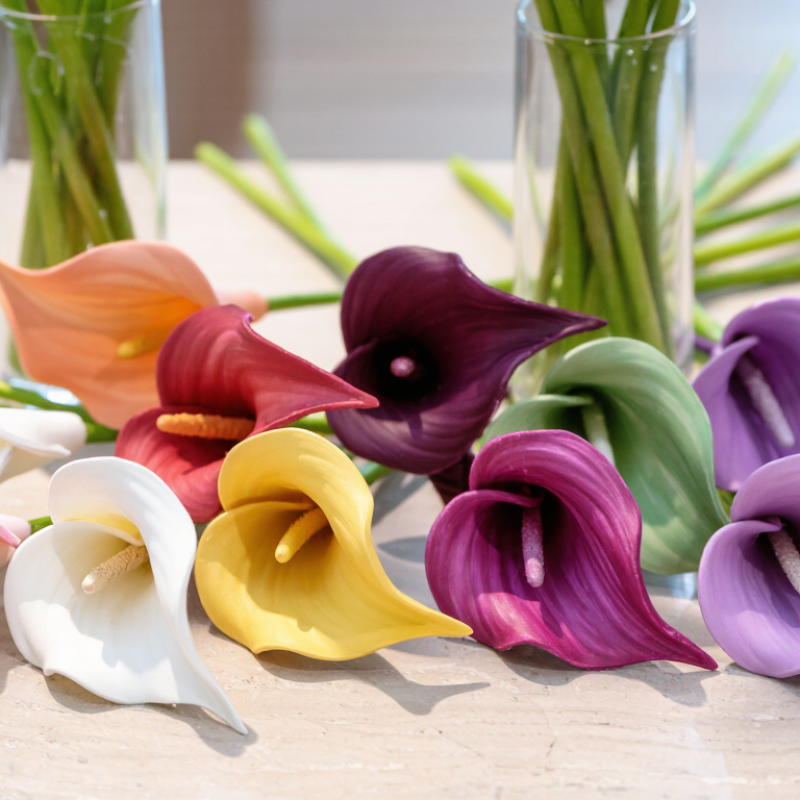
Real-touch calla lilies are artificial flowers engineered to imitate the weight, bend, and surface feel of fresh blooms. Common materials include polyurethane, silicone, latex-free coatings, and layered fabric. Materials differ by supplier. A silicone-coated petal may feel cool and slightly yielding, while polyurethane often provides sharper edges and stable color. Some stems contain molded plastic cores with flexible wire. The phrase “real-touch” is not a universal certification. Buyers should request material details and inspect close-up samples.
Popular choices include open trumpet blooms, closed buds, mini callas, variegated petals, and long-stem designs. They work well in wedding displays, home décor, hotel arrangements, and retail windows. Their main advantage is consistent appearance without watering or rapid wilting. Keep them away from strong heat and direct sunlight, especially when coatings are soft. In my experience, dust gathers quickly around the curved throat of the flower. A narrow, dry brush helps.
Quality depends on more than softness. Check whether petals return to shape after gentle pressure. Look for clean seams, balanced stems, realistic color transitions, and secure leaf attachments. A strong chemical odor may indicate poor finishing or insufficient airing time. Ask for production photos, sample measurements, and care instructions. Small imperfections can look natural, but uneven cuts and loose wires suggest weak control. I once accepted a soft sample with beautiful color, yet its stem bent too easily. That mistake reminded me to test structure, not touch alone.
Top 10 Types of Real Touch Calla Lilies for Buyers
Real touch calla lilies are best compared by bloom form, flower size, and stem height. The trumpet form usually measures 8–12 cm, with elegant 50–70 cm stems. Open-cup blooms range from 7–10 cm and suit relaxed bouquets. Flared blooms measure 6–9 cm, while closed buds measure 5–7 cm and add a natural growth stage. Double-layer forms reach 8–11 cm and create a fuller display. Ruffled forms, usually 7–10 cm, look softer and less formal. Curved blooms measure 6–9 cm and work well in asymmetrical arrangements. Mini cup forms stay near 5–7 cm, with 30–45 cm stems for small vases. Broad-petal blooms reach 9–12 cm and provide stronger visual weight. Asymmetrical blooms, commonly 7–10 cm, give mixed arrangements a less manufactured appearance.
Tips: Match bloom size to vase width. A 5–7 cm flower can disappear in a large container. Check whether the 30–70 cm stem includes the flower head. Some sellers measure only the wired section. Gently bend one stem and inspect its recovery. A realistic finish should feel slightly waxy, not sticky or overly smooth. Color variation between petals can improve realism, although uneven dye may look accidental. That is worth checking in daylight. I have found that slightly imperfect shapes often look more convincing than identical blooms. Still, excessive creasing can suggest poor storage. Choose a balanced mix of forms instead of ten identical flowers.
Classified by bloom form, 5–12 cm bloom size, and 30–70 cm stem length
This buyer reference compares common calla lily display forms using practical florist dimensions. Bloom size is measured across the widest visible opening, while stem length is measured from the base to the bloom tip. Larger trumpet and funnel forms suit statement arrangements, while mini cup and narrow trumpet forms work well for compact designs.
Top 10 Types of Real Touch Calla Lilies for Buyers
Real-touch calla lilies usually use latex, PU, PE, or PVC finishes. Each material changes the flower’s surface, bend, and price. Latex feels soft and slightly warm, making it convincing under close inspection. It also shows fingerprints and may age faster in heat. PU offers a dry, velvety texture with better shape recovery. It is often a mid-to-high cost option. PE feels firmer and cleaner, while molded details remain sharp. PVC is usually the budget choice, but it can feel glossy and less natural.
The ten useful buying types include matte latex, textured latex, soft PU, velvet PU, flexible PE, molded PE, matte PVC, glossy PVC, mixed-material stems, and layered finishes. In my purchasing experience, PU suits premium displays, PE suits repeated handling, and PVC fits large-volume decoration. Prices vary by mold complexity, stem wiring, and order quantity. A rough sourcing pattern places PVC lowest, followed by PE, latex, and PU, though exceptions are common.
Market context matters. PlasticsEurope reported 400.3 million tonnes of global plastics production in 2022, showing the scale behind PE and PVC supply. Grand View Research projects continued growth in the artificial flowers market through 2030, driven by durable, low-maintenance décor. These figures support material availability, not automatic quality. Buyers should request samples, bend stems repeatedly, and inspect color under daylight. I once trusted a soft surface too quickly; it looked realistic, but the stem failed after limited handling.
Assess Realism Through Color Gradients, Veins, Petal Detail, and Wire Cores
The artificial flowers market was valued at about USD 1.6 billion in 2023, according to Grand View Research. That growth reflects stronger demand for lifelike home decoration. For buyers, realistic calla lilies deserve closer inspection than simple color matching.
The ten popular types include white, ivory, blush, pink, rose, burgundy, yellow, orange, green, and purple calla lilies. White petals should show soft cream shading near the throat, not a flat plastic tone. Blush and pink varieties look more convincing with uneven gradients. Subtle veins should follow the natural petal curve. They should not appear printed.
Touch matters.
Real-touch petals usually have a slightly cool, flexible surface with gentle resistance. A flawless finish can look artificial. Small asymmetries often improve realism. Examine the curled edge, inner funnel, and pointed tip. Thin raised veins should remain visible under ordinary indoor light. A 2024 IMARC Group report also identifies premium texture and realistic appearance as key growth factors in artificial flower purchasing.
Check the stem wire carefully. It should bend smoothly but hold a natural angle. Exposed metal, stiff plastic, or an overly straight stem reduces credibility. I sometimes prefer a slightly imperfect petal fold; perfect symmetry feels manufactured. Color samples can also vary between batches, so buyers should request close-up photos before ordering.
When buying real touch calla lilies, appearance is only the starting point. Confirm the minimum order quantity before discussing colors, lengths, or custom cartons. A low MOQ may suit a trial order, while larger quantities often support better shade consistency. Ask for written figures, not verbal estimates.
Stem gauge needs equal attention. Specify stem diameter, length, flexibility, and acceptable tolerance in millimeters. A stem that looks elegant may bend during arranging or shipping. Request a production sample and measure it yourself. Small differences matter. Keep records.
UV performance should be verified through ISO 4892-3 testing, not vague claims like “sun resistant.” Request the test method, exposure cycle, irradiance, duration, specimen photographs, and color-change evaluation. The test does not guarantee unlimited outdoor life. Conditions still differ between a bright shop window and a humid garden.
Packaging should protect petals, stems, and surface texture separately. Check inner spacing, moisture barriers, carton strength, drop-test results, and pallet stability. Ask whether each lily has a sleeve or a shaped divider. Inspect a packed sample after simulated transport. It may reveal crushed tips or bent stems. Those details are easy to miss during approval.
A reliable supplier should provide traceable batch information, inspection records, and clear replacement terms. Be careful with attractive samples; production quality can vary.