

Top 10 Types of Air Breakers for Global Buyers
Choosing the right Air Breaker is no longer a simple catalog exercise. Industrial buyers now compare breaking capacity, rated current, arc-chamber design, maintenance access, and digital protection features. A dusty factory panel may demand a different solution than a clean data center switchboard.
MarketsandMarkets estimates that the global circuit breaker market could reach approximately USD 9 billion by 2028. Fortune Business Insights also reports steady growth, driven by grid modernization, renewable generation, and expanding industrial infrastructure. These figures describe the broader circuit breaker sector, not Air Breaker products alone. That distinction matters. Market reports often group air, molded-case, and vacuum technologies together.
This guide examines ten Air Breaker types used by global buyers. It considers low-voltage air circuit breakers, draw-out and fixed versions, current-limiting designs, and intelligent models with communication functions. Selection should follow verified technical data, not attractive product photographs. IEC 60947-2 remains an important reference for low-voltage circuit-breaker performance and testing.
Electrical safety author John Cadick offers a useful reminder: “Safety is not a gadget, but a state of mind.” His words fit Air Breaker selection well. A breaker can be powerful, yet poorly coordinated protection can still create dangerous faults. Installation quality matters. So does routine testing.
Some classifications remain imperfect. Manufacturers may use different labels for similar configurations. Buyers should confirm rated voltage, short-circuit withstand, trip-unit settings, environmental limits, and certification documents before purchase. The strongest choice is rarely the most expensive one. It is the breaker that matches the real load, fault level, maintenance practice, and future expansion plan.
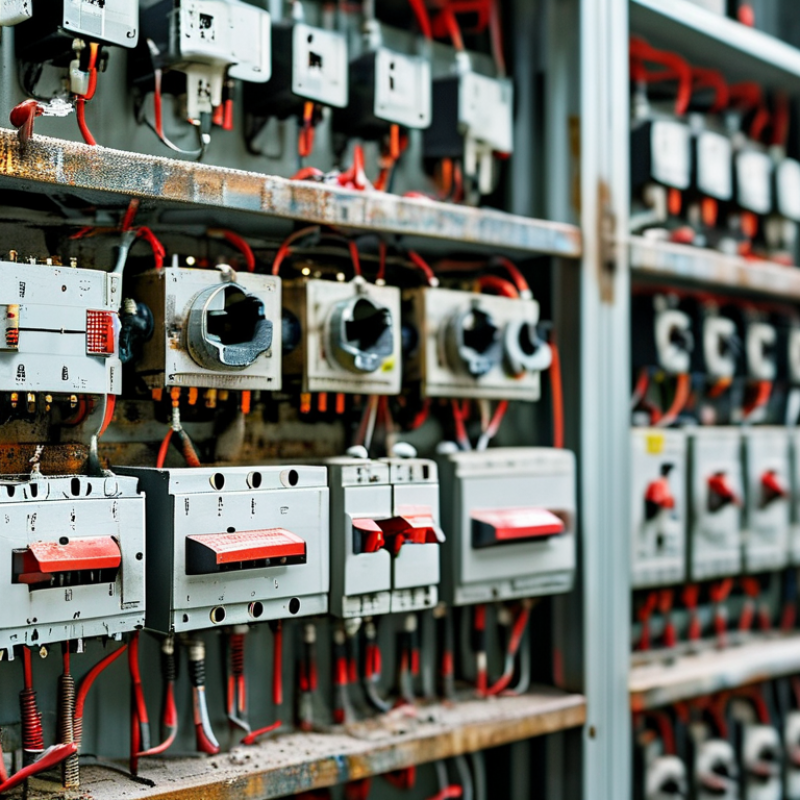
Air Breakers: Definition, Working Principle, and Main Applications
Top 10 Types of Air Breakers for Global Buyers
An air breaker, or air circuit breaker, interrupts fault current through atmospheric air. It is widely used in low-voltage distribution systems, often above 630 amperes. When a fault occurs, the trip unit releases the operating mechanism. Contacts separate rapidly. The resulting arc enters arc chutes, where metal plates divide, cool, and extinguish it. Thermal-magnetic, electronic, fixed, withdrawable, current-limiting, and maintenance bypass designs are common categories. Each suits different installation conditions.
The International Energy Agency’s Electricity 2024 report expects global electricity demand to grow by about 3.4% annually from 2024 to 2026. This growth increases pressure on reliable switchboards, data centers, factories, hospitals, and commercial buildings. Air breakers provide overload, short-circuit, and ground-fault protection. Electronic trip units can also support adjustable settings and event monitoring. IEC 60947-2 remains a key reference for low-voltage circuit-breaker performance. However, selecting only by rated current is an incomplete approach. Breaking capacity, busbar compatibility, ambient temperature, enclosure size, and service access matter equally.
Tips: Confirm the prospective short-circuit current first. Check whether the breaker is fixed or withdrawable. Review trip curves, communication needs, and spare-part availability. A field inspection should verify cable heating and connection torque. Small installation details can change long-term reliability. That lesson is easy to underestimate.
Top 10 Types of Air Breakers for Global Buyers - Air Breakers: Definition, Working Principle, and Main Applications
| No. | Air Breaker Type | Definition and Main Function | Working Principle | Typical Electrical Range | Main Applications | Key Buying Considerations |
|---|---|---|---|---|---|---|
| 1 | Low-Voltage Air Circuit Breaker (ACB) | A reusable circuit breaker that uses atmospheric air to insulate and extinguish the arc in low-voltage power systems. | When a fault occurs, the trip unit opens the main contacts. Arc runners, splitter plates, and magnetic forces lengthen, cool, and divide the arc until it is extinguished. | Typically up to 1,000 V AC; frame currents commonly from about 630 A to 6,300 A. | Main switchboards, generator outputs, transformer incomers, large commercial buildings, and industrial distribution systems. | Rated current, short-circuit breaking capacity, service breaking capacity, trip-unit functions, protection coordination, and installation clearance. |
| 2 | Fixed-Mounted ACB | A permanently installed ACB whose main and control connections remain secured inside the switchboard. | The contacts open in air during overload or short-circuit conditions. A thermal, magnetic, or electronic trip release initiates the opening mechanism. | Commonly up to 1,000 V AC and several hundred to several thousand amperes. | Standard distribution boards, utility rooms, factories, infrastructure facilities, and installations where breaker replacement is infrequent. | Lower purchase cost, cabinet depth, terminal accessibility, maintenance procedure, and isolation requirements. |
| 3 | Draw-Out ACB | An ACB mounted on a carriage so it can be moved between connected, test, and isolated positions without removing the complete breaker from the switchgear. | The interruption process is the same as an ACB, while primary and secondary plug-in connections allow controlled isolation and testing. | Commonly up to 1,000 V AC; current ratings often range from about 630 A to 6,300 A. | Data centers, hospitals, airports, process plants, utility substations, and other systems requiring reduced maintenance downtime. | Interlocking, racking mechanism, test position, compartment compatibility, spare-unit strategy, and arc-flash safety procedures. |
| 4 | Thermal-Magnetic Air-Break MCCB | A molded-case circuit breaker that interrupts current in atmospheric air and combines thermal overload protection with instantaneous magnetic short-circuit protection. | A bimetal element responds to sustained overcurrent, while an electromagnetic trip responds rapidly to high fault current. Opening contacts divide and cool the arc in an arc chamber. | Typically up to 1,000 V AC; commonly from about 16 A to 1,600 A, depending on frame size. | Feeder protection, commercial buildings, small and medium industrial equipment, HVAC systems, and distribution panels. | Adjustability, interrupting rating, pole configuration, enclosure size, terminal type, and ambient-temperature derating. |
| 5 | Electronic-Trip Air-Break MCCB | An MCCB using electronic sensing and a trip processor to provide more precise overload, short-time, instantaneous, and sometimes ground-fault protection. | Current transformers measure load current. The electronic trip unit compares the measured value with programmed thresholds and releases the opening mechanism when required. | Typically up to 1,000 V AC; commonly used from about 100 A to 1,600 A or more. | Critical feeders, power-management systems, industrial plants, commercial towers, and installations requiring selective coordination. | Long-time and short-time settings, ground-fault protection, communication capability, metering accuracy, and auxiliary power requirements. |
| 6 | Current-Limiting Air-Break MCCB | An air-interrupting MCCB designed to reduce the peak fault current and let-through energy during a short circuit. | Special contact geometry and fast repulsion increase arc voltage and interrupt the fault before the prospective current reaches its maximum value. | Usually low voltage, commonly up to 1,000 V AC; interrupting ratings vary widely and may exceed 50 kA. | High-fault-current distribution boards, motor control centers, transformer secondary feeders, and compact switchboards. | Peak let-through current, I²t energy, tested combinations, available fault current, and compatibility with downstream equipment. |
| 7 | Miniature Air Circuit Breaker (MCB) | A compact low-voltage breaker for final circuits, generally using thermal-magnetic protection and an air arc chute. | The bimetal trips under overload, the magnetic element trips under high short-circuit current, and the arc chute splits and cools the arc. | Commonly up to 440 or 480 V AC; typical ratings are approximately 0.5 A to 125 A. | Residential circuits, lighting, socket outlets, control panels, small commercial buildings, and light equipment. | Trip curve, pole count, rated short-circuit capacity, terminal compatibility, busbar system, and local installation standards. |
| 8 | DC Magnetic-Blowout Air Breaker | A DC circuit breaker that uses magnetic blowout coils or permanent magnets to drive the arc into an arc chute because DC has no natural current zero. | The magnetic field forces the arc to lengthen and move through splitter plates, increasing arc voltage until the current falls to zero. | Low- and medium-voltage DC systems; voltage and current ratings depend strongly on pole arrangement and interruption design. | Battery energy-storage systems, railway auxiliaries, industrial DC drives, telecommunications power, and renewable-energy DC feeders. | DC voltage per pole, polarity, series-pole requirement, short-circuit current, reverse-current capability, and tested DC breaking capacity. |
| 9 | Air-Break Switch-Disconnector | A manually or motor-operated air-insulated switching device intended to carry and isolate current; it normally does not provide automatic overload or short-circuit protection. | Opening contacts create an air arc that is controlled by contact spacing, arc horns, and arc runners. A separate fuse or circuit breaker is usually required for fault protection. | Low-voltage systems up to about 1,000 V AC or 1,500 V DC, with ratings from small panel currents to several thousand amperes. | Visible isolation, maintenance switching, photovoltaic arrays, battery systems, bus couplers, and industrial distribution equipment. | Utilization category, isolation function, visible contact position, short-time withstand current, motor operator, and interlocking. |
| 10 | Air-Blast Circuit Breaker | A high-voltage circuit breaker that uses a high-pressure air blast to cool, de-ionize, and extinguish the arc. | Compressed air is released through a nozzle when the contacts separate. The airflow removes ionized particles and rapidly restores dielectric strength. | Historically used from medium voltage to extra-high voltage; largely replaced in new high-voltage projects by other technologies. | Legacy transmission substations, industrial high-voltage systems, and installations where existing compressed-air infrastructure is available. | Maintenance of compressors and air reservoirs, operating noise, moisture control, spare parts, insulation coordination, and lifecycle cost. |